Tag

Marijean jaggers and social media

Come for the SEO, Stay for the Relationships

By Social Media

I’ve been at this social media bit for awhile. Longer, in fact, than we called it that. Long enough ago that the word blogger was whispered, like it was cancer.

I’ve adapted to new tools and the updates of existing tools and every day I’ve learned something new. One thing hasn’t changed through all of it though and it’s this: what really matters here are the relationships.

Sure, I might focus my content in a specific area to generate new visitors. I might narrow the focus again to try to attract people who might be interested in my help. But I guarantee it’s the relationship that is formed from the interaction between visitors and content producers that keeps people involved in the conversation.

I read the blog posts of people I’ve talked to on Twitter. I have followed the blogs of people I’ve met in person or heard speak at conferences. I’ve struck up conversation with people because others follow them and talk to them. I’ve been thrilled to pieces when one of the big guys in my industry have replied to something I’ve said.

When there’s something geographically, philosophically, politically, etc. I see that I think will be of interest to them, I share it. They often do the same for me. When there’s something that will benefit them, I reach out. The favor is often returned.

I’ve made real, true friends in this online space, some of them I’m closer to than my own colleagues at work (or at least interact with more often). People I admire and respect — people like Ken Mueller, Matt Ridings, Stephen Bolen (who totally had my back during kayakgate), Eric Kelley (who is totally getting some Gooey Butter Cake from me this week!), my BFF Gini Dietrich and my newest friend Paula Berg.

Today’s food for thought? Don’t lose sight of the big picture when you’re mired in SEO and content development. It’s the people you meet along the way that make all the difference.

No One Cares About Your Blog

By Social Media

Here’s the deal: no one cares about your blog. No one cares about your status updates or your Twitter feed. No one.

The fact is, people care about you.

Once again I’m reminding you that social media is about relationships. No one has a relationship with a website; they have a relationship with the person who updates it, the person who posts the content that is the tweet or the update or the photo, the video or podcast.

It’s true, no one cares about your blog, but a lot of people care about you. Think about that before you post. Are you posting as a person or as a corporate bot? Are you posting as a friend, trying to make the world a better place, or as a content generator trying to boost SEO.

People do business with people.

10 Things to Do On Your Facebook Fan Page

By Communications

So many companies, retail stores, nonprofits, restaurants and small businesses are making a colossal mistake. They’re creating Facebook profiles for their businesses — not pages.

Here’s the difference: I am a person, so I have a Facebook profile. It looks like this:

FB profile

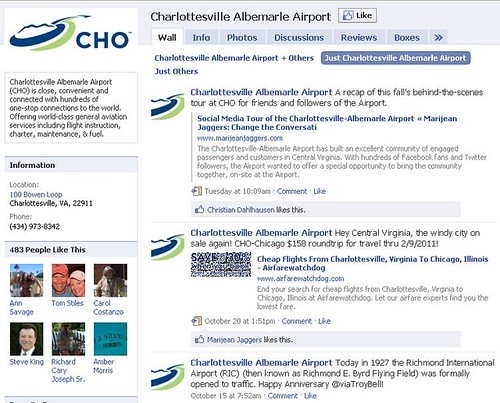
This is the Facebook page for the Charlottesville-Albemarle Airport (client).
CHO page

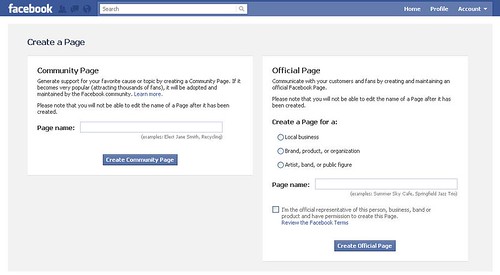
It’s not easy to figure this out, since Facebook changes almost daily but what you want for your business or organization is an Official Page, as seen below on the right. NOT a Community Page, which is the choice on the left.

Official FB page

Once you’ve set up your official Facebook Page, here are 10 things you can do with it, to generate “likes” or fans and build your community.

1. Add all events and post them

2. Post photos from events

3. Ask the community questions

4. Introduce topics for discussion

5. Feature key volunteers/members

6. Provide educational material

7. Link to external articles and other content of interest to the organization

8. Pass along special offers to the community when available

9. Celebrate organization “wins”

10. Inform the community about legislation and advocacy action they can take when appropriate.

Six Ways to Change the Conversation Using Social Media

By Social Media

As part of the social media presentation I gave to a nonprofit organization recently, I said: “prepare for the negative.”

It’s a good line; it gets attention and more importantly it encourages thought and preparation before engaging in social media. Whether you’re a small company, a large for-profit entity, a nonprofit or an individual practitioner you need to prepare for the negative and decide what you’re going to do about it when it happens.

Where there’s something to criticize, there will be a critic. It’s not necessarily a bad thing to have critics; valid feedback and constructive criticism can help you make your service and your business better. As an example, see how Domino’s Pizza has used customer feedback in a constructive way to improve their business.


“You can either use negative comments to get you down or you can use them to excite you and energize your process.” — Patrick Doyle, President, Domino’s Pizza.

Here are six ways you can take back lost business by changing the conversation:

1. Listen and respond. Learn what’s being said about your business by using social media monitoring tools, customer surveys, secret shops and focus groups. Find out what the negative is so you can develop a plan to address it.

2. Allow visibility. It’s a huge leap from where we were as a culture in using public relations and the dreaded “spin” to allowing the public to see your downfalls, your weaknesses and mistakes. It is critical to the current culture of customer service that you allow comments on your blog, that you allow customers to interact with you in the places they are online (Facebook, Twitter, etc.)

3. Reward feedback by thanking those who provide it and include them in the conversation of how you can make your service or your products better.

4. Respond to everything – let the public know you’re listening — we often find that people are more polite when they know you’re in the room.

5. Be accessible. Make sure you’re actually available on the social networks you’ve set up — if you have a Twitter account, you must be managing it.  Provide your phone number and answer the phone! Provide an e-mail address or a contact form and make sure you’re following up.

6. Share the story of how you took a negative conversation and turned it around. Did you get a bad score on a customer service survey? What did you do to improve? Share the differences with your audiences and they will respect you for making the honest effort.

Moderating Blog Comments: The Discussion on Spin Sucks

By Communications

Oddly enough, I’m only posting this to drive you to another blog post on another site. I really want you to read this post: Moderating Blog Comments on Spin Sucks, the fight against destructive spin. Pay attention to the conversation unfolding in the comments themselves. It is a discussion worth your time and consideration.

The handling of blog comments – to moderate, to not moderate and all that resides between the two – has long been discussed. Many of us have different opinions on the topic. Personally, I don’t moderate, meaning, I don’t approve or delete comments before they appear — they are automatically published and if the comment is in violation of my comment policy, then I will remove it later. I’ve only had to do this once in about seven years of blogging so for me, it works.

I’m interested in this conversation though, and how Livefyre, the tool helping the conversation happen, will change the way we interact using comments on blogs.

Join the conversation — what do you think about moderating blog comments?