All Posts By

Marijean

Hallelujah: Social Media and the Church

By Social Media

Reverend J. shot me a note on Facebook, looking for advice on how his church should or could be using social media.  So we had an old-school conversation via telephone (whoa!) to discuss it. Churches that have adopted social media have found success and nothing made social media go more mainstream within faith-based organizations than when the Catholic church (perhaps the slowest-t0-change religion of all) endorsed the use of social media to communicate with others and those outside the church. In other words, when the Pope has a YouTube channel, it’s time to pay attention to social media across other denominations.

Rev. J had three main questions.

1. Should we be using Twitter? (with a side comment of, “I just don’t get Twitter.”)

2. What should we do first?

3. What about YouTube?

These are all good questions.  Now, the answers:

1. We did some research using Tweepz to determine how many active users were in the congregation’s small town. There weren’t many, but the search turned up a faith-based user and several users in an adjacent community. Given the low adoption of Twitter in the Rev’s community, I recommended he watch the conversation. It’s likely the Twitter community will grow, but creating an account and starting to follow the local conversation as well as looking for other faith-based organizations will, no doubt, lead to inspiration, helping the Rev. to “get” Twitter. If nothing else, Rev. J. should know that Twitter represents a huge opportunity to drive people to the church’s web-based content. And, I said, you never know when someone may be seeking prayers via a tweet.

2. There are 500 million active Facebook users. My estimate is that a good 70 percent of the congregation has a Facebook profile and of these, at least half are on Facebook daily. I’m not making these stats up. It’s good to go to the people, when you know where the people are. It’s also likely that church members will enjoy gathering online as much (more?) as they do gathering in the sanctuary. As a method of spreading the word virtually and growing the flock, Facebook is a winner, as often we find that friends have influential power over us. If one of my friends belongs to a church and is enthusiastically sharing the church’s content, inviting friends to events and generally making me aware of the church and its offerings AND if I happen to be seeking a church . . . I will certainly have my friend’s church in my field of vision.

3. Video is extremely important to consider as a marketing and PR tool. YouTube is the #2 search engine, second only to Google. Turns out, video is a cake walk for the church — music is a big part of the church’s services and events and is often recorded. Since video is easier than ever to capture and upload, the church has a real opportunity to share it’s musical ministry online. Sharing clips of services on YouTube (and then, across platforms including — and very importantly — on the church’s website “home base”) to introduce and invite people to visit and perhaps join the church is a great idea. Even if sharing the church’s musical ministry doesn’t bring in a single new member of the congregation, people may find what the church has to offer, right when they need it the most. And that’s part of a church’s mission, right?

Social media and ministry go together like nuns and comfortable shoes. Harness the power of social media to reach the people right where they are and without a doubt, your congregation will grow.

The Four-Step Framework for Nonprofits Thinking about Social Media

By Social Media

I spend a lot of my time coaching and teaching nonprofit organizations on how to use social media. It’s not that simple of a task to take on, and nonprofits should not take the plunge into the social web lightly. It is super important for nonprofits to take this seriously and start getting organized — the tools of social media are free and more effective than any other marketing or mass media tactics used by nonprofits in the past.

There is a simple four-step framework for organizations to think about and to use to guide the process of developing a plan to use social media.

1. Read. Watch. Listen.

There are multiple tools to monitor what’s being said on the social web, but the important thing is to identify your geographic community, the search terms to look and listen for, the bloggers, the news feeds, the Twitter users — and to create all these searches in easy-to-follow alerts and notifications so you can quickly and efficiently stay on top of what is important to your community and, what your community is saying about your organization as well. You’re going to be watching videos, reading blogs and news items, following Twitter users and overall, paying attention to the content created in and about your community.

2. Find and Connect to Your Community.

The definition of community is not limited to geography. Sometimes geography plays a role; sometimes it does not. Maybe your community is the people in Ohio who love Soft-Coated Wheaten Terriers. Maybe the community is comprised of only people who have a rare and particular kind of disease. No matter — a community is a group that has one or more interests in common. Find them by searching for them and inviting them to your network. Find them and follow their content. Find them by uploading the contacts you have already made professionally, as a student, as a family member and a community member into your social networking platforms (LinkedIn, Facebook, Twitter, etc.) and connect to the people who already have a presence in these social networks.

3. Interact with the Community.

Answer a question. Reply to a tweet or re-tweet something others will find of interest. Click that “like” button often. Leave comments on blogs and on Facebook. Share other people’s links often. Be helpful. And — when the opportunity presents itself for your community to get together in person — at a conference, a tweetup or just for a cup of coffee, go and put faces with names.

4. Produce Valuable Content.

Take photos and publish them. Blog. Tweet. Make a video and post it to YouTube. Create interesting and thoughtful content and share it with your community to help them, make them stronger, to bring them together (and on and on).

It’s a simple framework, but not a simple execution — but it may help your organization take the first step toward getting a handle on how to tackle social media for the community’s benefit.

Introducing Jaggers Communications

By Jaggers Communications News, Uncategorized

Yesterday, I shared news on my personal blog that makes the focus of this blog a bit more evident. You may have even noticed some changes around this site, such as the introduction of a new page and a new business name.

I’m very pleased to announce that beginning January 3, 2011, I will launch Jaggers Communications. I will be using my experience in agency and corporate communications work to help businesses and nonprofits reach their business goals through strategic marketing, content creation, public relations and social media.

The tag line in the logo says it all – the work provided by Jaggers Communications is strategic — there will always be a correlation between our clients’ business goals and the communications efforts we produce on their behalf. We’re social — as in, we use social networks, social media and social strategy as a vehicle to drive a campaign forward. Social will always be an element of an overall strategic communications plan — not the plan itself. Smart is not only about using our brains to support your business, it’s about developing goals that are specific, measurable, actionable, realistically high and time-bound. SMART. See?

There are four industry categories we will continue to serve: health care, education, tourism and manufacturing (especially of the green variety.)

I am indebted to the reputation management firm Standing Partnership, my employer for the past five years, for giving me the experience, the confidence and the blessing to go out on my own and continue as my mentors and friends.

I am eagerly anticipating the adventure that awaits and I look forward to working for, and collaborating with many new friends and established contacts.

All the News that’s Fit to Tweet

By Communications

A friend in the broadcast news business asked me what I thought about a news organization tweeting what comes over on the police scanner. It’s common practice for newspapers, radio stations and television stations to keep an ear cocked toward the police scanner, a fixture in any newsroom. It can be the first source for a story that is unfolding and may help a news crew get to the scene before the competition.

Often, though, a lot of nonevents and false alarms are reported – it takes a practiced ear to separate the news from the mundane and even then, false reports sometimes leak through.

So the question is, should news organizations be tweeting those first, early reports — the unsubstantiated buzz — heard on the scanner?

My position on this is that we look to the news organizations for fact — we trust them to be verifying the news they’re reporting and if there’s a change or an update, to report that as well. I want to trust that a news Twitter feed is actually NEWS; there are plenty of other Twitter accounts to tweet the rumors.

I applaud news organizations for recognizing that Twitter is a place they need to be, to share information and respond to the community, but I strongly caution management and news directors of these organizations to have the discussion internally about how Twitter should be used, and to be aware that anything the organization publishes or broadcasts on any platform can impact the integrity of the organization.

What do you think?

Casual Restaurants Doing Social Media Right in Charlottesville

By Social Media

Recently, I took a look at a selection of fine dining establishments in Charlottesville to see which were using social media platforms to attract customers.

Many readers pointed to examples of restaurants that are using social media, and doing it well — but all of these are in the casual dining category — which is what I’m devoting this post to covering.

Three standout examples in the area include Revolutionary Soup, BBQ Exchange (in Gordonsville, Va.) and Beer Run.

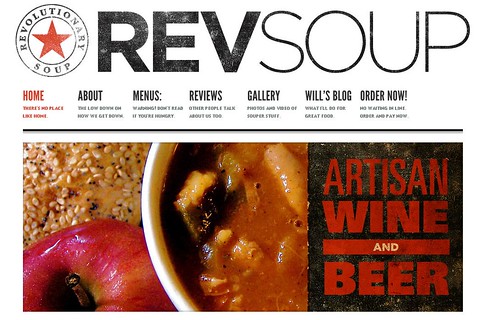
Revolutionary Soup is by far, the leader of the pack. Will’s Blog is featured as a main element of the restaurant’s website, with the passion and philosophy of restaurant owner Will Richey coming through loud and clear. The blog is not updated often but posts are thoughtful and have a single-minded purpose, sharing the process of bringing locally grown and nurtured food to the community. Three categories say it all: local, Rev Soup Farm and seasonal specials. I’m particularly impressed with Rev Soup’s website – a design that incorporates a page for reviews, suggested beer and wine pairings and daily or seasonal specials. (It’s no surprise when, upon investigating, I learn that the site was done by my very talented friend Michael Davis of Yellowfish.)

Revolutionary Soup is on Twitter, with an account for its Corner location and what looks like the “main” Twitter account for its downtown shop.

Rev Soup

There’s some opportunity for the Corner account to improve its bio, add a photo, increase followers and friends — but assuming that the focus is primarily on the downtown location, I focused on Twitter.com/@RevSoup. I like the way the account is being used, with tempting descriptions of recipes and daily soup offerings, mixed with observations from Will like, “Marker drawing all over my fav cook book. Should have known the 2 year old was not as impressed with Tournedos Rossini as I.” This kind of tweet, and indeed, all the real interaction from Will and the staff on the social web humanizes the brand and builds its loyalty. One might argue that the soup and sandwiches do that on their own, but if you’ve never been to Rev Soup, you don’t know that, do you?

When there’s more to say than what will fit in a Tweet, the restaurant uses its Facebook page, a smart way to use the additional presence — and to share good content with nearly 500 fans.

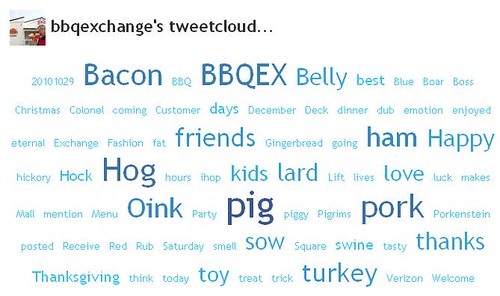
The BBQ Exchange is off the beaten path out in Gordonsville and, if you’re not inclined to leave the city of Charlottesville, a destination brand designed to tempt you on a short road trip with delicious smoked pork and spicy fried pickles as a reward. Craig Hartman is using Twitter and Facebook to get the word out to a broader audience than those in the immediate vicinity, a smart strategy for a restaurant that also serves customers’ catering needs. The restaurant has integrated its tweets into the home page of the website as a way to keep the home base of the online presence fresh. You can follow BBQ Exchange on Twitter (not recommended for vegetarians as main topics include pork, bacon and pork. ) As proof, here’s a recent Tweetcloud from the account:

BBQexchange

Last, but certainly not least is one of my personal favorites, Beer Run. While the operation’s website leaves a lot to be desired, and does nothing to point fans to its presence in social media, Beer Run’s Facebook page updates have driven me to tastings or special events on more than one occasion.  It’s disappointing to see Beer Run’s Twitter account so underutilized – there are thousands of engaged Twitter users in our community and yet Beer Run is following only one other user. I challenge Beer Run to get connected to the Twitter community by following and engaging with them, tapping into the power there to promote events or to boost traffic when business is slow.

While this is merely a selection of restaurants using social media well in a couple of ways in the Charlottesville area, I’m sure there are more that are worth a mention. Let me know in the comments if there are any I should see.