I’m very pleased to announce that beginning January 3, 2011, I will launch Jaggers Communications. I will be using my experience in agency and corporate communications work to help businesses and nonprofits reach their business goals through strategic marketing, content creation, public relations and social media.
The tag line in the logo says it all – the work provided by Jaggers Communications is strategic — there will always be a correlation between our clients’ business goals and the communications efforts we produce on their behalf. We’re social — as in, we use social networks, social media and social strategy as a vehicle to drive a campaign forward. Social will always be an element of an overall strategic communications plan — not the plan itself. Smart is not only about using our brains to support your business, it’s about developing goals that are specific, measurable, actionable, realistically high and time-bound. SMART. See?
There are four industry categories we will continue to serve: health care, education, tourism and manufacturing (especially of the green variety.)
I am indebted to the reputation management firm Standing Partnership, my employer for the past five years, for giving me the experience, the confidence and the blessing to go out on my own and continue as my mentors and friends.
I am eagerly anticipating the adventure that awaits and I look forward to working for, and collaborating with many new friends and established contacts.
Many readers pointed to examples of restaurants that are using social media, and doing it well — but all of these are in the casual dining category — which is what I’m devoting this post to covering.
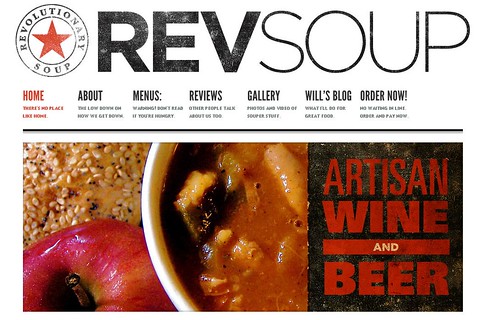
Revolutionary Soup is by far, the leader of the pack. Will’s Blog is featured as a main element of the restaurant’s website, with the passion and philosophy of restaurant owner Will Richey coming through loud and clear. The blog is not updated often but posts are thoughtful and have a single-minded purpose, sharing the process of bringing locally grown and nurtured food to the community. Three categories say it all: local, Rev Soup Farm and seasonal specials. I’m particularly impressed with Rev Soup’s website – a design that incorporates a page for reviews, suggested beer and wine pairings and daily or seasonal specials. (It’s no surprise when, upon investigating, I learn that the site was done by my very talented friend Michael Davis of Yellowfish.)
There’s some opportunity for the Corner account to improve its bio, add a photo, increase followers and friends — but assuming that the focus is primarily on the downtown location, I focused on Twitter.com/@RevSoup. I like the way the account is being used, with tempting descriptions of recipes and daily soup offerings, mixed with observations from Will like, “Marker drawing all over my fav cook book. Should have known the 2 year old was not as impressed with Tournedos Rossini as I.” This kind of tweet, and indeed, all the real interaction from Will and the staff on the social web humanizes the brand and builds its loyalty. One might argue that the soup and sandwiches do that on their own, but if you’ve never been to Rev Soup, you don’t know that, do you?
When there’s more to say than what will fit in a Tweet, the restaurant uses its Facebook page, a smart way to use the additional presence — and to share good content with nearly 500 fans.
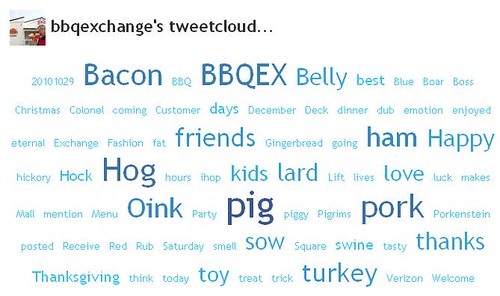
The BBQ Exchange is off the beaten path out in Gordonsville and, if you’re not inclined to leave the city of Charlottesville, a destination brand designed to tempt you on a short road trip with delicious smoked pork and spicy fried pickles as a reward. Craig Hartman is using Twitter and Facebook to get the word out to a broader audience than those in the immediate vicinity, a smart strategy for a restaurant that also serves customers’ catering needs. The restaurant has integrated its tweets into the home page of the website as a way to keep the home base of the online presence fresh. You can follow BBQ Exchange on Twitter (not recommended for vegetarians as main topics include pork, bacon and pork. ) As proof, here’s a recent Tweetcloud from the account:
Last, but certainly not least is one of my personal favorites, Beer Run. While the operation’s website leaves a lot to be desired, and does nothing to point fans to its presence in social media, Beer Run’s Facebook page updates have driven me to tastings or special events on more than one occasion. It’s disappointing to see Beer Run’s Twitter account so underutilized – there are thousands of engaged Twitter users in our community and yet Beer Run is following only one other user. I challenge Beer Run to get connected to the Twitter community by following and engaging with them, tapping into the power there to promote events or to boost traffic when business is slow.
While this is merely a selection of restaurants using social media well in a couple of ways in the Charlottesville area, I’m sure there are more that are worth a mention. Let me know in the comments if there are any I should see.
My friend Ginger Germani was “helping” me find some shoes online the other day. It started with her razzing me about my choices, then Ginger said, “I’m not a complainer without solutions.”
I liked that, and that’s a good model to follow. I’ve tried to do that on this blog; when I note a company not communicating well or using social media to its full benefit (or making a colossal mistake) I follow it by sharing what they should do, or tips to help them improve.
Create a chef’s blog that’s updated frequently (at a minimum, once a week). Use it to share new menu items, local ingredients and the occasional recipe. Make liberal use of photos and video, but don’t let that be the sole content on the blog.
Work with FourSquare to offer special deals to the Mayor of your restaurant.
Set up social web monitoring alerts to let you know when a community member is asking friends on Twitter, “Where’s a good place to take my boss out to dinner in C’ville?” or “I’m looking for a good C’ville restaurant for my mom’s birthday.” Be responsive when these conversations occur. Recognize the Twitter user when they come in and reward them for the interaction (you’ll likely have a customer for life).
Create special, behind-the-scenes content or offers for fans of the restaurant on Facebook. Let the fans name a new dish, or offer to host a Tweet-up on an otherwise slow evening or at a time the restaurant is normally closed.
Follow members of the community on Twitter and ask them what you can do to better serve them — the people who follow your restaurant become your online focus group.
Monitor the social web for mentions of your restaurant, in case anyone posts about a bad experience (they will; I promise, no matter how great your restaurant is.) Before you find these mentions, develop a plan to react and respond to negative comments and make sure anyone who acts on the restaurant’s behalf, knows and understands the plan. Remember always that in the case of a negative customer experience, the right, first thing to say is “I’m sorry,” followed by, “how can we make it better?”
Share the love. Look, no one is going to eat at your restaurant every night. The culture of social media rewards those who share, and who recognize others. Following other restaurants, retweeting their content, commenting on their blog posts, sharing their special offers won’t hurt your business, it will earn you respect in the social community. Respect is loyalty and loyalty means customers that come back to see you again and again.
Social media is a fantastic tool for restaurants who can time tweets to tempt us with menu offerings right when we’re starting to get hungry for lunch or dinner.
They can help us out by reminding us to make reservations for that special birthday or anniversary coming up.
They can offer to help us out of a bind by sharing menu options that suit the vegetarian or gluten-free guest coming to visit.
In short, restaurants are a vibrant part of our community, there’s no reason why they shouldn’t be reaping the benefits of being part of our online community as well.
C & O Restaurant has a blog, which has post from May and . . . November. Can we expect that posts will now pick up with some regularity?
Maya is on Facebook but they have set up a profile, not an official page for the business (this is the wrong approach — read more about pages vs. profiles here). One shouldn’t have to “friend” a restaurant. You can like a restaurant, but it’s really tough to be friends with it (you never call me!)
Michie Tavern may be one of the oldest restaurants in Charlottesville, but they’re still hip enough to be using social media. The historic restaurant has a Facebook page and they allow fans to comment on the wall (sometimes they interact with those who have posted there.)
Escafe has a blog. OK, not really. I’m sorry I made you go look, but they should be, too.
Downtown Grille surprised me with a Facebook page and a Twitter presence. This old-school, steaks, bourbon and cigars establishment doesn’t seem like it would be leading the pack in social media use, but indeed, there they are. While I’m thrilled to see Downtown Grille using Twitter, there’s room for improvement with more frequent tweets and interaction — I want to be tempted to come to the restaurant with tweets about menu items and specials. Just a reminder of the fabulous meals I have had there makes me want to go.
This is a selection of some of the finer restaurants in Charlottesville – others, including Ivy Inn, Hamilton’s, Fleurie, The Local, L’Etoile, have no discernible social media presence, other than the throngs of locals and visitors blogging and tweeting about them, posting their visits to their Facebook profiles or checking in on FourSquare.
In upcoming posts I’ll look at what other, more casual dining establishments are doing with social media and how it’s working for them. I’ll also share some tips on what these businesses could be doing, to gain a competitive edge and remain top of mind with those dining out in Charlottesville.
In the last few years I’ve noticed an uptick in the number of local car dealerships ending their television commercials with “Friend us on Facebook, follow us on Twitter.”
I became curious about what the local social media scene among the automotive brands really looks like and decided to conduct a small independent study.
Price Kia is the first dealership that appears in a Google search that has an evident social media presence on its home page. The Kia dealership’s Facebook Page has 248 “likes,” 30 photos and four videos but not a lot of engagement or customer interaction.
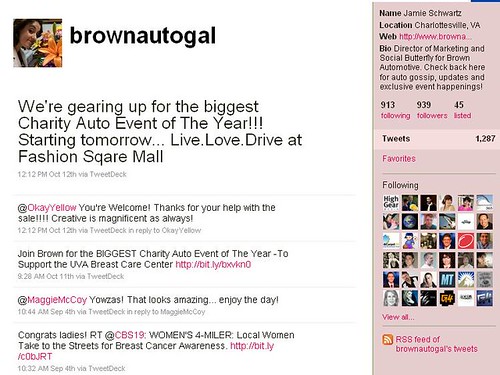
Brown Automotive is the second leader in the Google search, and has a Facebook Page with only 141 “likes;” surprising because this dealership is so engaged in the local community. Twitter is where this dealership really stands out and that is largely due to www.twitter.com/brownautogalWhat really makes Brown’s social media engagement successful is that Brown Automotive’s Twitter presence has a face and a voice — and these belong to Jamie Schwartz, aka Brown Auto Gal.
Flow Volkswagen Charlottesville only offers a Facebook page for customer engagement. The page has only 50 “likes,” but offers good content, helpful tips and reminders. With such great content, it’s too bad that Flow Volkswagen isn’t living up to its social media potential.
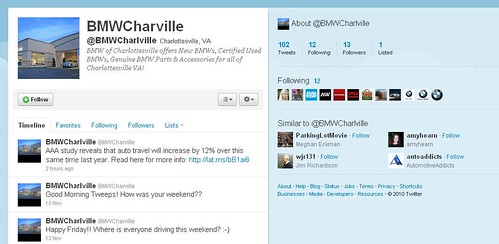
BMW of Charlottesville earns points for having Facebook and Twitter badges on its website home page, making it clear to their community where to engage. BMW’s Facebook page is active so it’s surprising that it has only 30 “likes.” The dealership also has a Twitter account, but they seem to be a bit confused about it — the account is http://twitter.com/bmwcharlville but the bio lists it as BMWCharville:
The Twitter account needs some help. A keyword-rich bio should be added and it should be evident who the person is behind the account. There are thousands of engaged Twitter users in our community – and yet BMW of Charlottesville is only following 12.
There is definitely some untapped potential for social media engagement in the car sales arena in Charlottesville. I see plenty of people in our community tweeting and posting on Facebook about a need for a new car, recommendations for where to get a car fixed or the next car they should purchase. With such a competitive marketplace, these dealerships should take a hard look at how they can pull ahead of the others with some simple social media strategy.


 Flow Volkswagen Charlottesville